
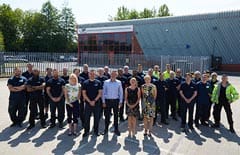
 Our Team
 Our History
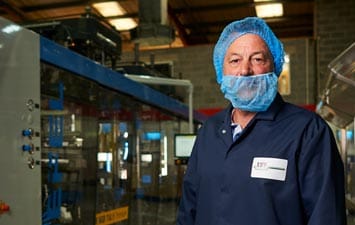
LVF Eyes Expansion
Leeds Vacuum Formers (LVF) has invested £600,000 in a Kiefel KMD 78 Speedformer – a move that will lead to the creation of new jobs, increase manufacturing capacity and open…
Continue ReadingPlastic packaging hasn’t strayed far from the public eye since 2017. But as a company that utilises plastic in both manufacturing processes and the products we sell, the eradication of plastic waste has been a key issue for us for many years.
Lorem ipsum dolor sit amet, consectetur adipisicing elit, sed do eiusmod tempor incididunt ut labore et dolore magna aliqua. Ut enim ad minim veniam, quis nostrud exercitation ullamco laboris nisi ut aliquip ex ea commodo consequat. Duis aute irure dolor in reprehenderit in voluptate velit esse cillum dolore eu fugiat nulla pariatur.
Excepteur sint occaecat cupidatat non proident, sunt in culpa qui officia deserunt mollit anim id est laborum. Sed ut perspiciatis unde omnis iste natus error sit voluptatem accusantium doloremque laudantium, totam rem aperiam, eaque ipsa quae ab illo inventore veritatis et quasi architecto beatae vitae dicta sunt explicabo. Nemo enim ipsam voluptatem quia voluptas sit aspernatur aut odit aut fugit, sed quia consequuntur magni dolores eos qui ratione voluptatem sequi nesciunt. Neque porro quisquam est, qui dolorem ipsum quia dolor sit amet, consectetur, adipisci velit, sed quia non numquam eius modi tempora incidunt ut labore et dolore magnam aliquam quaerat voluptatem.
Lorem ipsum dolor sit amet, con sectetur adipisicing elit, sed do eius mod tempor incididunt ut labore et dolore magna aliqua.
When talking about biodegradable plastics, it’s important to understand the definition of the biodegradation process. By definition, plastics that fragment or degrade through chemical reactions, ultraviolet radiation and / or mechanical processes are not biodegradable. They are simply degradable and in most cases leave toxins; heavy metals like cadmium, nickel and cobalt; and residues of the polymer in the environment.
Plastics are hydrocarbons that come from crude oil and are 100 per cent biodegradable thanks to oleo-physeal bacteria. However, in the process of distillation its original organic nutrients are burned. Additionally, manufactured plastic products are designed to be durable. All of which explains why traditional plastics take thousands of years for the microbes in them to decompose.
“For many years LVF has recycled close to 100 per cent of all waste we produce”
The organic additives used in Breakdown PET accelerate the biodegradation of treated plastics in microbe-rich environments. The material uses organic, carbon based ingredients that enable polymers to biodegrade like organic matter. Products made from Breakdown PET have an unlimited shelf-life and are completely non-toxic.
Breakdown PET actually attracts microbes to the product, where they colonise on its surface, and secrete acids that break down the polymer chain. Once the polymer chain is opened the microbes utilise the carbon backbone as a source of food and energy, and biodegradation occurs at the atomic level.
The difference between Breakdown PET and traditional plastic is that Breakdown PET creates an opportunity for microbes to utilise plastic as food and energy, which accelerates biodegradation. The end result of biodegraded Breakdown PET is the same as that of any biodegraded organic matter – humus, CO2 and CH4 that can be captured to produce clean, cheap energy.
Leeds Vacuum Formers (LVF) has invested £600,000 in a Kiefel KMD 78 Speedformer – a move that will lead to the creation of new jobs, increase manufacturing capacity and open…
Continue Reading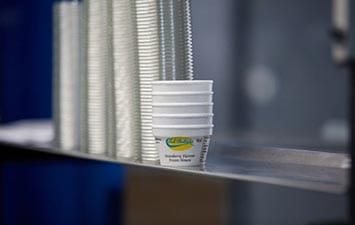
LVF has secured a contract to supply ice cream and frozen dessert manufacturer, CoolDelight Desserts, with the lids for all its individual portion ice cream pots.
Continue Reading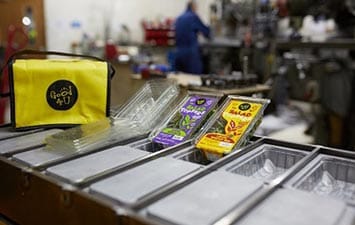
Leeds Vacuum Formers (LVF) has invested £600,000 in a Kiefel KMD 78 Speedformer – a move that will lead to the creation of new jobs, increase manufacturing capacity and open…
Continue Reading